
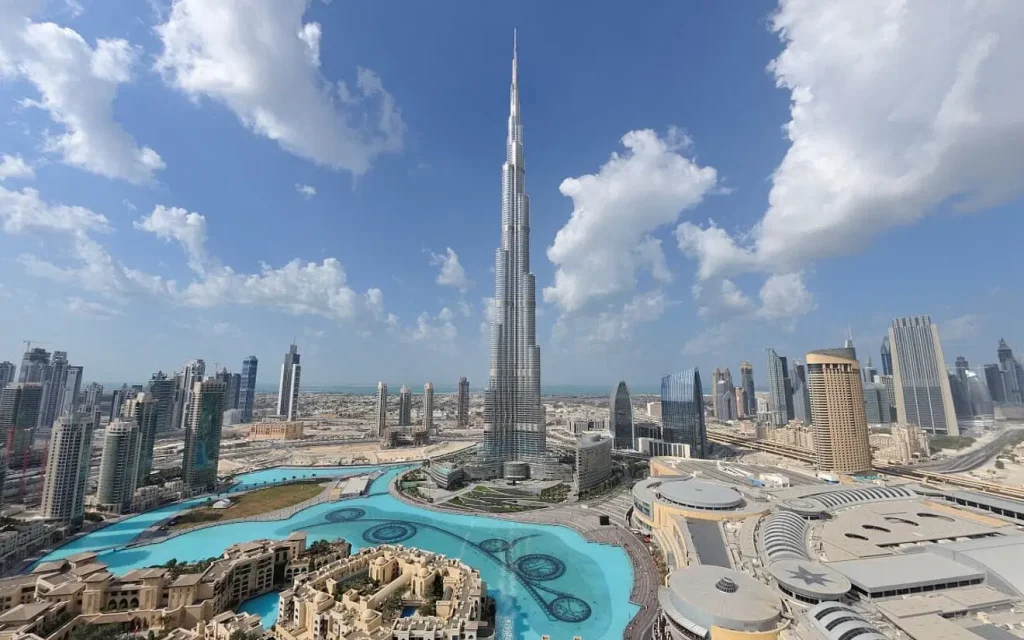
The world’s skyline continues to reflect bold engineering and architectural ambition, with supertall buildings pushing the limits of design and technology.
While the ranking of the tallest towers has remained relatively stable over the past decade, new completions and revived mega-projects in 2026 are shifting attention toward the next generation of “kilometre-high” structures.
1. Burj Khalifa (Dubai, UAE) – 828 metres
Since its completion in 2010, the Burj Khalifa has retained its position as the tallest building globally. Designed by Skidmore, Owings & Merrill, its Y-shaped structure—modelled after the Hymenocallis desert flower—helps minimise wind impact.
The tower functions as a vertical city, housing the Armani Hotel, residences, and offices, with high-speed elevators leading to observation decks overlooking the Persian Gulf.
2. Merdeka 118 (Kuala Lumpur, Malaysia) – 679 metres
Now ranked second, Merdeka 118 recently surpassed the Shanghai Tower. Its design reflects the gesture of Malaysia’s first Prime Minister during independence in 1957.
Featuring a diamond-shaped glass façade, the tower has become a luxury hub, home to the Park Hyatt and Southeast Asia’s highest observation deck, “The View at 118.”
ALSO READ: You don’t need January to start over: 10 ways to reset for Q2
3. Shanghai Tower (Shanghai, China) – 632 metres
Renowned for sustainability, the Shanghai Tower features a 120-degree twist that reduces wind load and construction costs.
Its double-layered glass façade improves insulation, while wind turbines near the top help power the building’s lighting system.
4. Makkah Royal Clock Tower (Mecca, Saudi Arabia) – 601 metres
Part of the Abraj Al Bait complex near the Grand Mosque, this tower is famous for its massive clock faces, visible from 25 kilometres away.
The structure includes a lunar observation centre and a large prayer hall, crowned by a prominent golden crescent.
5. Ping An Finance Center (Shenzhen, China) – 599 metres
Built with 1,700 tons of stainless steel, this skyscraper is designed to withstand Shenzhen’s coastal conditions. Its “Free Sky” observation deck offers panoramic views, including a glass-bottomed platform for visitors.
6. Lotte World Tower (Seoul, South Korea) – 555 metres
This 123-storey tower blends modern design with traditional Korean aesthetics. Engineered to withstand major earthquakes, it also incorporates renewable energy systems. Its Seoul Sky observatory features one of the world’s highest glass-floor viewing decks.
7. One World Trade Center (New York City, USA) – 541 metres
Standing at a symbolic 1,776 feet, this tower represents the year of U.S. independence. Its design echoes the original Twin Towers, with a geometric glass façade that forms a striking, tapering structure.
8. Guangzhou CTF Finance Centre (Guangzhou, China) – 530 metres
Known for its ultra-fast elevators, this mixed-use tower combines offices, residences, and a luxury hotel. Its terracotta-accented exterior reflects traditional Chinese materials.
9. Tianjin CTF Finance Centre (Tianjin, China) – 530 metres
Distinguished by its curved glass exterior, this tower is designed to reduce wind resistance and building sway. Its smooth, reflective surface creates a dynamic visual effect in the skyline.
10. CITIC Tower (Beijing, China) – 528 metres
Also known as China Zun, this building draws inspiration from an ancient Chinese ritual vessel. Its distinctive “waisted” design required advanced engineering and now defines Beijing’s central business district.
As new projects emerge, the race toward even taller, kilometre-scale buildings is expected to redefine skylines and push architectural innovation further.