
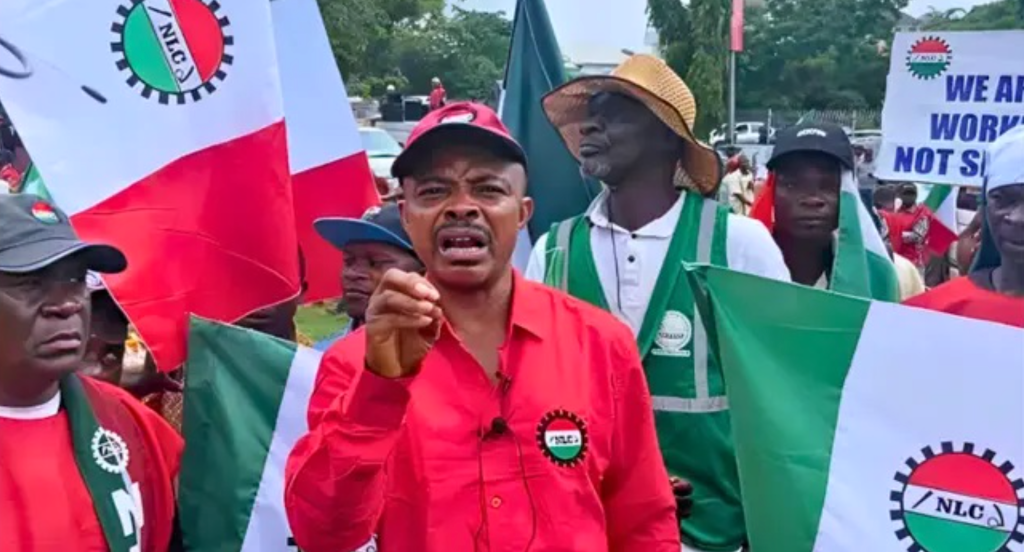
The Nigeria Labour Congress (NLC) on Wednesday staged a nationwide protest, calling on the Federal Government to deploy the full machinery of governance to tackle the worsening insecurity threatening lives, livelihoods and national stability.
Workers, labour leaders and civil society allies gathered at the NLC Secretariat in Abuja, insisting that the protest was neither sectional nor partisan, but driven by a collective resolve to rescue the country from escalating violence and criminality.
Although participants began arriving at the protest ground before 7:30 a.m., the demonstration formally commenced between 11:15 a.m. and 11:39 a.m. as protesters waited for directives from union leaders.
The delay followed a prolonged closed-door meeting involving NLC President, Comrade Joe Ajaero, and other labour leaders. The meeting came shortly after an earlier engagement between NLC leaders and President Bola Tinubu over the planned protest.
Addressing workers, the Deputy General Secretary of the NLC, Comrade Ismail Bello, said the protest was about the survival of Nigeria and the well-being of all citizens, not just workers.
ALSO READ: Insecurity: NLC mobilises workers for nationwide protest
“What we are doing today is not just for workers alone; it is for all Nigerians,” Bello said. “As citizens, we have surrendered our sovereignty to government with the expectation that lives will be secured and the economy managed in the interest of the majority, not a privileged few.”
He lamented the heavy toll insecurity has taken on communities and livelihoods, noting that teachers, health workers, transport workers and other citizens have borne the brunt of the crisis.
“We are reminding the world of the calamity that has befallen many communities. The damage is enormous and it must stop,” he added.
Bello also stressed that the right to peaceful protest is constitutionally guaranteed, warning that no authority has the power to silence workers.
“We are here to remind government that nobody can gag us from exercising our right to freedom of association and peaceful assembly,” he said.
Calling for decisive action against kidnappers, terrorists and criminal networks, Bello said the continued failure to punish perpetrators had emboldened insecurity across the country.
“People must return to their communities. Children should go back to school. Teachers and students must be protected. All government needs to do is deploy the full machinery of governance to recover all spaces taken over by criminals,” he said.
Also speaking, the Head of the NLC International Department, Comrade Uche Ekwe, said the protest was aimed at strengthening the government’s resolve to confront insecurity head-on.
“If government is committed, we want to strengthen their hands. Those funding insecurity must be identified, arrested and dealt with,” Ekwe said.
The NLC said insecurity in Nigeria, which has persisted for nearly two decades, has been characterised by terrorism, banditry and kidnapping, with devastating consequences for workers, families and the economy.
Labour disclosed that since 2009, more than 2,295 teachers have been killed by insurgents and bandits, while over 19,000 teachers have been displaced across Borno, Yobe and Adamawa states. It added that over 910 schools were destroyed, forcing about 1,500 learning centres to shut down or be converted into camps for internally displaced persons.
In the health sector, the NLC said about 35 per cent of healthcare facilities were destroyed by terrorism, while 50 per cent became inaccessible in the North-East. Dozens of health workers were reportedly kidnapped or killed between 2021 and 2024, worsening the shortage of medical personnel.
The NLC linked the insecurity crisis to deep-rooted socio-economic injustice, corruption, inequality and poor funding of education and health sectors, warning that the economic costs have been staggering. It cited an estimated ₦300 billion loss during the 30 days of the JOHESU strike alone as a reflection of the wider crisis.
Labour said the protest marked the beginning of sustained action to reclaim Nigeria from insecurity and called for reforms, including making Chapter Two of the Constitution justiciable, strengthening security trust funds, accelerating the prosecution of corrupt officials, reforming the judiciary and ensuring wage justice.
The congress described the protest as the first step towards national healing, insisting that the struggle was about securing a safer future for all Nigerians.