
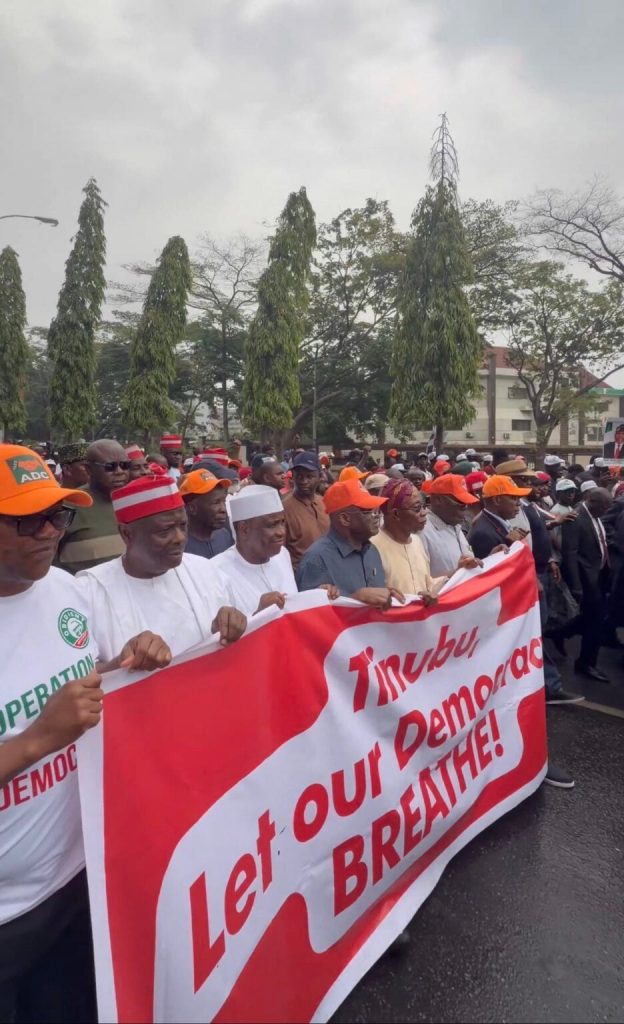
Leaders and members of the African Democratic Congress (ADC) on Wednesday staged a protest in Abuja, accusing the Independent National Electoral Commission (INEC) of actions they said threaten democracy and the party’s internal leadership structure.
The protest, tagged #OccupyINEC, attracted several prominent opposition figures, including former presidential candidates Atiku Abubakar, Peter Obi, and Rabiu Kwankwaso.
Others present were Rotimi Amaechi, Rauf Aregbesola, Aminu Tambuwal, and Dino Melaye. The demonstration began at Maitama Roundabout, with hundreds of Kwankwasiyya supporters also in attendance.
Participants sang Nigeria’s former national anthem, “Arise, O Compatriots!”, despite its replacement on May 29, 2024, by President Bola Tinubu with the country’s 1960 independence anthem, “Nigeria, We Hail Thee.”
Confirming his participation, Atiku said the protest was aimed at defending democratic values. He wrote on X, “Myself and other leaders of the ADC are peacefully protesting against the partisanship of the electoral umpire. Our patriotic stance is aimed at safeguarding our democracy and preventing the enthronement of a dictatorship. -AA”
ALSO READ: Dangote key to tackling Africa’s food security challenges — UN
Speaking on behalf of ADC members and other opposition leaders, Peter Obi called on Nigerians to resist threats to democratic governance.
He said on X: “We, members and leaders of the ADC, and other well-meaning Nigerians, lovers of democracy, are saying that our democracy must not be killed.
“We say NO to a one-party system, and for that, today we’re calling out Nigerians who believe in unity, peace, and security of our country to join us as we defend democracy in our land.”
The protest comes after INEC announced it would no longer accept correspondence from factions of the ADC led by Senator David Mark and Nafiu Bala, following a Court of Appeal ruling on the party’s leadership dispute.
ADC and other opposition groups have criticised the decision, describing it as an interference in the party’s internal affairs and a restriction on its autonomy.