
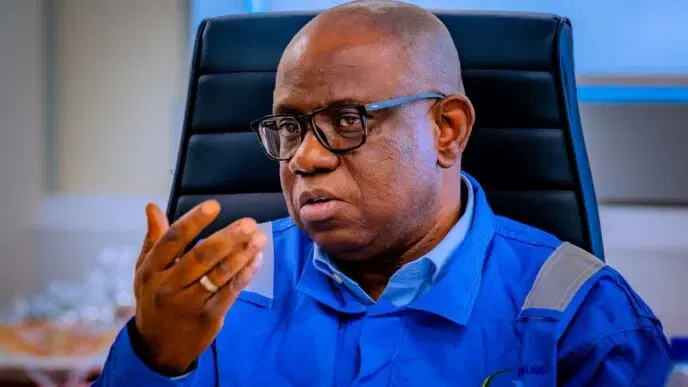
The Group Chief Executive Officer of NNPC Limited, Engr. Bayo Ojulari, has said the company does not currently have the capacity to operate a refinery, describing the restart of the Port Harcourt Refinery and Petrochemical Company as a misuse of resources.
Ojulari made the remarks on Wednesday while speaking at the 2026 Nigerian International Energy Summit.
He said running a refinery requires strong financing, capable Engineering, Procurement and Construction (EPC) contractors, and solid operational and maintenance expertise—conditions he noted NNPC does not presently have.
The Port Harcourt Refinery was rehabilitated at a cost of about $1.5 billion under the leadership of former NNPC GCEO, Mele Kyari. It reopened in November 2024 after nearly three years of rehabilitation but was shut again in May 2025 due to persistent financial losses.
Ojulari said a review of the refinery’s operations showed it was operating at a major loss.
“The first thing that became clear was that we were running at a monumental loss to Nigeria. We were just wasting money. I can say that confidently now,” he said.
ALSO READ: Unknown assailants kill ex-Libyan leader Gaddafi’s son
“So the first decision I had to make was to stop the rot by shutting it down and then quickly recalibrating to see what could be done.”
He questioned why the refinery continued to lose money despite receiving regular crude supplies.
“We were pumping cargo into the refinery every month, but utilisation was around 50 to 55 per cent. Those cargoes have value, and we were losing that value. We were spending a lot of money on operations and contractors.
“But when you look at the net outcome, we were just leaking value, and there was no clarity on how to turn those losses into positive returns,” he added.
Ojulari said NNPC is now looking to work with partners that have proven experience in refinery operations.
“To make a refinery work, you need three things,” he said. “First, financing to support operations. Second, a competent EPC contractor. Third, world-class operational capacity to run the refinery.”
He explained that the company’s current approach, approved by its board, is to partner with experienced refinery operators rather than service contractors.
“We are not looking for contractors. We are not looking for O&M service providers. We are looking for an entity that actually runs refineries,” he said.
Ojulari also said the successful operation of the Dangote Refinery has reduced the pressure to immediately revive government-owned refineries.
“There was a lot of pressure about continuity, but we were not under that pressure. And thank God for Dangote Refinery. Thank God. Whether you love Dangote or hate him, thank God.
“Thank God he is a Nigerian and not someone from another continent. Despite everything, that gave us breathing space because we now have a refinery that is working,” he said.
On oil production, Ojulari said Nigeria could reach 1.8 million barrels per day in 2026 but described the Federal Government’s 2025 budget benchmark of 2.06 million barrels per day as unrealistic. He noted that average production last year stood at about 1.7 million barrels per day.