
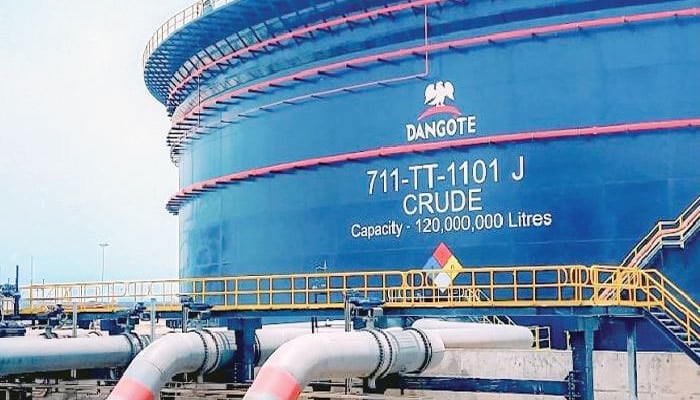
Mr Sunday Esan, Senior General Manager, Corporate Communications at Dangote Industries Ltd., says the Dangote Refinery has helped Nigeria save more than ₦10 billion in foreign exchange annually by replacing fuel imports with locally refined products.
Esan made this known on Thursday in Lagos during the 2025 Media Week of the Nigeria Union of Journalists (NUJ), Lagos State Council.
He explained that the refinery had reduced the country’s reliance on imported petroleum products.
“The refinery is more than a national landmark; it is reducing foreign exchange outflows, driving GDP growth, creating jobs, positioning Nigeria as a regional energy hub, and strengthening our national energy supply.”
Esan noted that the refinery, which started operations almost two years ago, has already contributed to the economy by cutting PMS and diesel imports, supporting the Naira, creating jobs, and improving the energy supply chain.
According to him, fuel imports dropped by 1.54 per cent in the first quarter of 2025.
“While Nigeria spent $2.6 billion on fuel imports in Q1 2024, the figure declined sharply to $1.2 billion in Q1 2025.
ALSO READ: VIDEO: Ammunition falls from moving bus heading to Katsina near ABU Zaria
“Dangote Refinery has saved Nigeria over ₦10 billion annually in foreign exchange by replacing imports with local production.
“It has significantly curtailed oil imports and created measurable economic impact,” he said.
On production capacity, Esan said the refinery was considering an increase from 650,000 barrels per day to 1.4 million barrels per day.
He added that global interest in the facility was growing, noting that Saudi Aramco and U.S. buyers had shown interest in its jet fuel.
Esan also spoke about the scale of the refinery, saying it covers an area about seven times the size of Victoria Island, Lagos, and requires at least five hours to tour by car.
“This shows the magnitude of the investment that one man, Alhaji Aliko Dangote, has brought to life,” he said.
He further stated that the acquisition of 4,000 CNG trucks for product distribution had created no fewer than 24,000 jobs.
Speaking on the media’s role in shaping national conversations on energy security, Esan urged journalists, especially NUJ members, to ensure accurate and informed reporting.
“We want your members to visit the refinery so your reports will be accurate and well-informed.
“When some people are bent on pulling it down, you will understand that this is a national asset we must protect,” he added.
In his remarks, Mr Udeme Akpan, Energy Editor at Vanguard Newspapers, said businesses benefit from strong media partnerships because they provide credible information needed for daily decision-making. He encouraged journalists to prioritise credibility to maintain trust with the business community.
Earlier in his welcome address, Mr Adeleye Ajayi, NUJ Lagos Chairman, described the lecture as an opportunity to discuss major challenges in Nigeria’s energy sector. He acknowledged government efforts to improve the sector.
Reacting to Esan’s comment on agenda-setting, Ajayi said the union had consistently set national agendas at both state and federal levels. He also called on Dangote Group and other stakeholders to remain open to working with the media.
Mr Wale Akodu, Chairman of the Press Week Committee, recalled the difficulties Nigerians faced in previous years, especially fuel scarcity during festive periods, noting that such situations have largely eased.