
In 1986, the Egba people did something that peoples across the world have done across centuries when they wish to hold memory against the erosion of time: they institutionalised it. The Lisabi Festival was born, a formal, annual act of remembrance for Lisabi Agbongbo Akala, the warrior and liberator who, centuries before, had united the Egba against the chains of Oyo imperialism and forged from that resistance a collective identity so durable it has survived colonisation, urbanisation, and the particular amnesia of modernity.
For 39 years, the Lisabi Festival has done its sacred work quietly and faithfully. It has gathered the Egba people around their shared story, reminded them of the sacrifice that made their unity possible, and kept the flame of ancestral memory burning with the kind of devotion that does not seek outside approval to feel legitimate.
But keeping a flame burning and carrying it outward into the world are two different acts of courage. The first is preservation. The second is transformative. And for a culture as rich and historically significant as Egba culture, the world’s ignorance of it has always been a wound, unspoken, but felt.
Egbaliganza arrived as an answer to that wound, conceived and propelled by Aare (Dr.) Lai Labode, the youngest individual to hold the title of Aare in Egbaland’s history and the most stylish Yoruba man as some call him. Egbaliganza made a bet that most institutions are too cautious to place: that global audiences, given the right presentation, would not merely tolerate Egba culture but would be arrested by it, moved by it, hungry for more of it.
Egbaliganza will serve as a comprehensive platform for creative expression spanning fashion, music, visual art, cultural tourism, economic development, and diaspora engagement, built on a single unyielding vision: that the story of the Egba people, and by extension the African people, will be told by Africans, on African terms, to a world that is ready to receive it.
More than ten nations engaged with the platform. Abeokuta, already storied in the Nigerian imagination as the city of the rock and the cradle of Nigerian nationalism, took on an additional identity, host city of one of West Africa’s most compelling new cultural events.
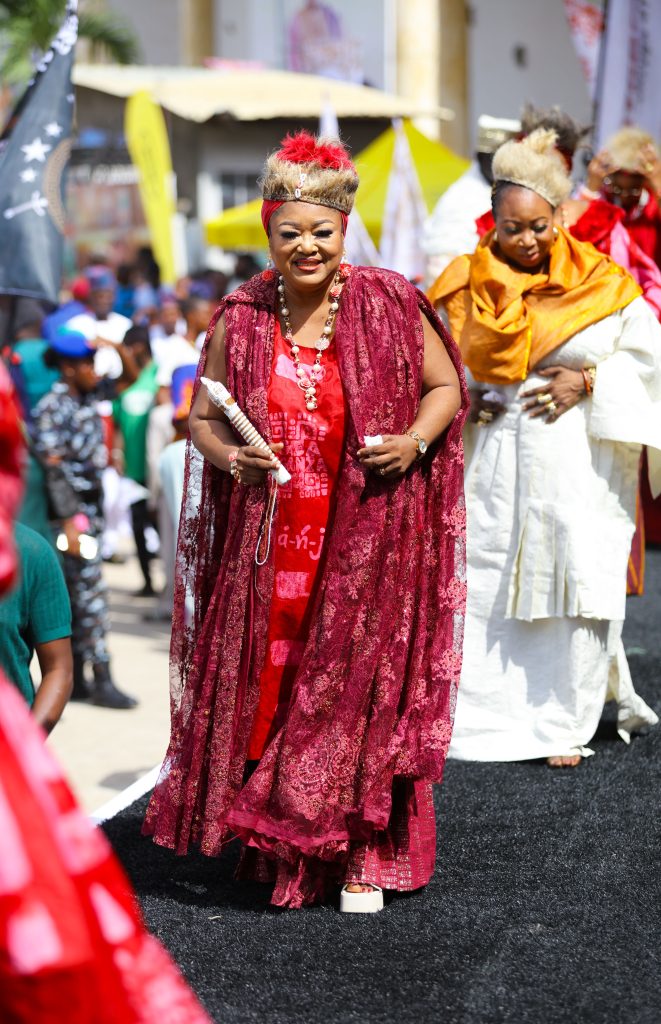
The production standard matched the ambition. The fashion drew comparisons that, just five years ago, would have seemed premature: a West African counterpart to the cultural weeks that define Paris and Milan, an African stage on which African aesthetics needed no translation or apology. Back home, Egbaliganza had transcended the festival, its attire designs adopted for weddings, naming ceremonies, and everyday life, becoming identity worn on the body.
The financial architecture behind this did not materialise by accident. Aare Lai Labode has invested billions of naira of personal capital into building Egbaliganza into what it has become, making Egbaliganza not just a fruit but the most singular investor or promoter of the Lisabi Festival.
That investment has funded not just spectacle but substance, the infrastructure, the international outreach, the programming that makes a cultural event repeatable and scalable rather than a one-off moment of brilliance.
The economic benefits to Abeokuta and its surrounding communities during Egbaliganza weekend have been documented and felt: a city that fills up, a local economy that breathes differently for those days, a hospitality and creative sector that experiences its most productive period of the year.
Looking at the platform’s declared trajectory, the scale of what is being attempted becomes clearer still. A 50-country reach is being actively pursued, an ambition that would make Egbaliganza one of the most geographically expansive cultural platforms originating from the African continent.
The 2026 edition will feature a 50-piece orchestral band, an international delegation of nations, federal government participation, policy signings, and a formal cultural exchange that positions Abeokuta as Africa’s annual cultural capital, echoing FESTAC 77’s declaration that African culture belongs on the world stage, and this time, the world is coming to Egbaland. Aso made in Egba, vintage materials sourced across Yorubaland, and attire as old as 3,000 to 4,000 years, all taking the Egbaliganza runway, alongside designs sewn by Lai Labode Couture.
It is against this backdrop of documented, verifiable, expanding achievement that the current campaign of reputational damage must be placed, because context is everything, and the critics are counting on you not to have any.
A circulating article, presented in the cadence of investigative journalism but bearing none of its discipline, has made the rounds on social media in recent days. It leans on anonymous sources. It gestures at institutional outrage without naming the outraged.
It raises questions about Egbaliganza’s relationship to Lisabi and to the Egba traditional council in terms designed to alarm without being specific enough to be challenged. It is, in the language of those who study information campaigns, a narrative designed not to inform but to inoculate, to plant sufficient doubt that the achievements become harder to celebrate cleanly.
What it does not mention, and this omission is the article’s most revealing feature, is that Egbaliganza successfully secured official Federal Government recognition for the Lisabi Festival. The platform that critics portray as a threat to Egba heritage is the same platform that gave that heritage formal national standing. That is not the behaviour of an entity seeking to privatise culture. That is the behaviour of an entity that understands cultural preservation requires institutional backing, and went and got it.
The origins of the campaign are, to those within the community, an open secret. Former participants of Egbaliganza, individuals who once stood on its platform, enjoyed its reach, and benefited from its growing reputation, departed under contested circumstances and subsequently established competing ventures. Unable to match what they left behind, some among them appear to have concluded that the next best option was to make what they left look less impressive than it is. The coordinated nature of the negative coverage, its timing, and its remarkable consistency of message all point to something more organised than spontaneous cultural concern.
What they have not accounted for is the Alake.
Oba Adedotun Aremu Gbadebo, the Alake of Egbaland, Colossus of Ake, and Paramount Ruler of the Egba people, is a leader whose reign has been defined by a clear and consistent vision: Egbaland, prosperous, united, and respected.
He is not a ceremonial figurehead content to bless occasions and remain above the fray. He is an active, engaged ruler who understands that the dignity of his people is inseparable from their economic and cultural visibility in the modern world. Sources also confirm that the Alake-Egbaliganza Drum, a landmark monument symbolising the union of Egba traditional authority and cultural renaissance, is in development, with its unveiling set to be one of Abeokuta’s most significant cultural moments yet.
In the current moment, sources confirm that the Alake has been engaged from the beginning, not as an alarmed observer scrambling to contain damage, but as a deliberate leader applying the full measure of his institutional authority to ensure that whatever internal tensions exist are resolved in a manner worthy of Egba tradition. Dialogue. Consensus. The patient, unhurried work of holding a community together across differences without allowing those differences to become the community’s defining story.
The Alake’s confidence in Egbaland’s ability to carry both heritage and growth simultaneously is not naivety. It is wisdom accumulated across a reign that has seen Egbaland navigate far more complex pressures than a social media controversy. He has seen what happens to communities that mistake internal conflict for cultural authenticity. He is ensuring, quietly and effectively, that Egbaland does not make that mistake now.
Lisabi Agbongbo Akala did not free the Egba people so that their descendants could spend their energy pulling down what each other built. He freed them so they could build, together, and at a scale commensurate with their history.
Egbaliganza is that building. The Alake is the guardian of the ground on which it stands. And the Egba people, at home and across the world, are watching to see who, in this moment, chooses legacy over grievance.
History, as it has always done, will remember the answer.