
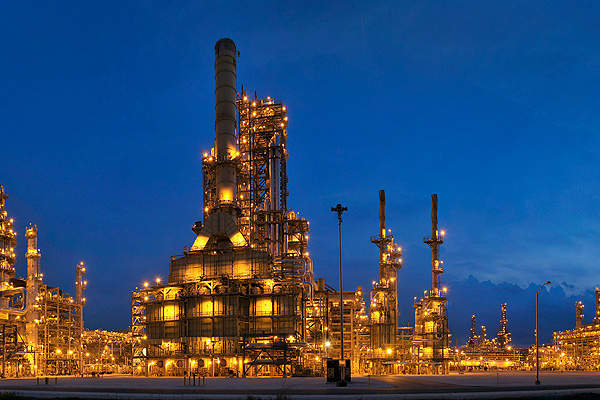
Oil refineries are the backbone of the global energy ecosystem, transforming crude oil into the fuels and petrochemical products that power industries, economies, and everyday life.
From early 20th-century engineering feats to 21st-century mega-complexes, these industrial giants drive the flow of global energy and trade. Below are the top 10 largest oil refineries in the world, ranked by refining capacity.
1. Port Arthur Refinery – United States (1903, Rebuilt 2002)
Operator: Motiva Enterprises
Located in Texas, the Port Arthur Refinery is one of the oldest and largest in the United States. Commissioned in 1903 and extensively upgraded in 2002, it currently refines around 600,000 barrels per day (bpd), serving as a key hub in America’s Gulf Coast energy corridor.
2. Baton Rouge Refinery – United States (1909, Expanded 2023)
Owner: ExxonMobil
Opened in 1909, the Baton Rouge Refinery in Louisiana is one of North America’s most advanced. Its current capacity stands at 520,000 bpd, and recent upgrades in 2023 have further strengthened its role in the U.S. energy supply chain.
3. Galveston Bay Refinery – United States (1931, Expanded 2019)
Owner: Marathon Petroleum Corporation
Commissioned in 1931, the Galveston Bay Refinery in Texas City processes 631,000 bpd. A major 2019 upgrade improved production efficiency and environmental performance, cementing its status as one of the top refining facilities globally.
4. Ras Tanura Refinery – Saudi Arabia (1945)
Operator: Saudi Aramco
In operation since 1945, the Ras Tanura Refinery is Saudi Arabia’s oldest and one of the world’s most strategically important oil facilities. With a refining capacity of 550,000 bpd, it remains central to Aramco’s downstream operations and global oil exports.
5. Paraguaná Refining Complex – Venezuela (1950s)
Operator: Petróleos de Venezuela, S.A. (PDVSA)
This massive complex combines three refineries—Amuay, Cardón, and Bajo Grande—bringing its total capacity to 940,000 bpd. Built in the 1950s, it remains one of the largest refining centers in the Western Hemisphere.
ALSO READ:BREAKING: Dangote refinery to expand capacity to 1.4million barrels per day
6. Ulsan Refinery – South Korea (1964)
Operator: SK Energy
Commissioned in 1964, the Ulsan Refinery has a refining capacity of 850,000 bpd, making it South Korea’s largest. Known for its advanced technology and wide product range, it supports both domestic and export markets.
7. Yeosu Refinery – South Korea (1969, Expanded 2021)
Operator: GS Caltex
Established in 1969 and expanded in 2021, the Yeosu Refinery processes 840,000 bpd. It is globally recognized for its high efficiency and environmentally friendly operations, setting a standard for modern refining technology.
8. Onsan Refinery – South Korea (1979)
Operator: S-Oil Corporation
Operational since 1979, the Onsan Refinery handles 669,000 bpd. It is renowned for producing ultra-clean fuels that comply with strict international environmental regulations.
9. Ruwais Refinery – United Arab Emirates (1982, Expanded 2015)
Operator: Abu Dhabi National Oil Company (ADNOC)
Built in 1982 and expanded in 2015, the Ruwais Refinery’s capacity stands at 827,000 bpd. As one of the largest refining complexes in the Middle East, it plays a vital role in ADNOC’s downstream and export strategy.
10. Jamnagar Refinery – India (1999, Expanded 2008)
Owner: Reliance Industries Limited
The Jamnagar Refinery in Gujarat, India, is currently the largest oil refinery in the world, with a capacity of 1.24 million bpd. Commissioned in 1999 and expanded in 2008, it is known for its efficiency, innovation, and global export capabilities.
11. Dangote Refinery – Nigeria (2023)
Owner: Dangote Industries Limited
Inaugurated in 2023, the Dangote Refinery in Lagos is Africa’s largest industrial project and a symbol of energy transformation on the continent. With a current capacity of 650,000 bpd, it aims to make Nigeria self-sufficient in refined petroleum products and a key exporter across Africa.
With the Dangote Petroleum Refinery announcing plans to expand its capacity from 650,000 bpd to 1.4 million bpd within the next three years, it could soon surpass all others to become the world’s biggest oil refinery once the expansion is completed.