
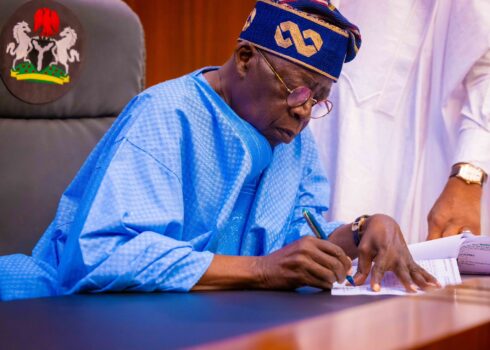
President Bola Ahmed Tinubu signed the ₦54.99 trillion 2025 Appropriation Bill into law on February 28, 2025. He signed the bill at the State House in Abuja with senior government officials and key members of the National Assembly in attendance. The new budget follows vigorous debate and a historic vote by lawmakers, which passed on February 13, 2025. Consequently, the final budget far exceeds the initial ₦49.7 trillion proposed by the President.
Furthermore, the budget reflects a remarkable nearly 100% increase from the previous fiscal year’s ₦27.5 trillion. It sets ambitious targets and allocates funds across critical sectors. For instance, the bill earmarks ₦3.65 trillion for statutory transfers, ₦13.64 trillion for recurrent non-debt expenditure, and ₦23.96 trillion for capital expenditure. In addition, it allocates ₦14.32 trillion for debt servicing, while maintaining a deficit-to-GDP ratio of 1.52%. These allocations demonstrate the administration’s commitment to fiscal discipline and robust economic growth.
Moreover, the budget includes a special allocation of $200 million. This sum aims to address significant gaps caused by the suspension of U.S. aid to Nigeria’s health sector. In doing so, the government intends to safeguard and improve health services for millions of Nigerians. In addition, the emphasis on capital expenditure signals a renewed focus on revitalizing Nigeria’s infrastructure. Many infrastructure projects are planned to boost transportation, power, and public utilities across the nation.
President Tinubu emphasized the importance of this budget during the signing ceremony. He declared, “The past year tested our resolve, but through economic discipline and strategic reforms, we achieved what many deemed impossible.” He also remarked, “We worked together as brothers and sisters… Today, we see a light at the end of the tunnel.” These powerful words resonated deeply with those present, and they underscored his vision of a transformed and resilient Nigeria. His remarks set an inspiring tone for the fiscal year ahead.
In addition, legislative leaders expressed strong optimism about the new budget. They praised the government for increasing funding significantly and addressing critical national challenges. Lawmakers pledged to oversee the proper implementation of the budget. They vowed to ensure that every naira is spent effectively to improve the quality of life for Nigerians. As a result, many citizens have regained hope in the government’s ability to deliver tangible results.
Furthermore, the budget reflects a balanced approach to growth and fiscal responsibility. The substantial increase in capital expenditure will stimulate economic activity and create jobs. At the same time, the allocation for debt servicing ensures that Nigeria’s financial obligations remain under control. Political analysts believe that the bill will empower the government to invest in key sectors such as security, education, health, and infrastructure. Consequently, the 2025 budget represents a bold plan for national development and economic renewal.
Additionally, experts note that the robust funding will help Nigeria achieve sustainable development goals. They argue that investments in infrastructure and social services can transform communities and reduce poverty. Furthermore, increased government spending is expected to spur private sector growth, which will further strengthen the economy. In this regard, the budget provides a clear roadmap for progress.
Moreover, the enactment of the ₦54.99 trillion budget comes at a critical time for Nigeria. The country faces multiple challenges, including economic instability, inflation, and infrastructure deficits. However, government officials remain optimistic. They assert that strategic reforms and disciplined fiscal management will help overcome these hurdles. In summary, the new budget is a bold statement of intent from President Tinubu and his administration.
Ultimately, as Nigeria embarks on the 2025 fiscal year, the government has laid a solid foundation for growth and development. With this historic budget, President Tinubu has taken a decisive step toward a brighter, more prosperous future. All eyes now turn to the effective implementation of the bill, which will determine how successfully Nigeria can achieve its ambitious development goals.
VIDEO: President Bola Ahmed Tinubu has signed into law the ₦54.99trillion 2025 Appropriation Bill.❤️🇳🇬 pic.twitter.com/796JnMsScq
— A. Ayofe (@abdullahayofel) February 28, 2025