
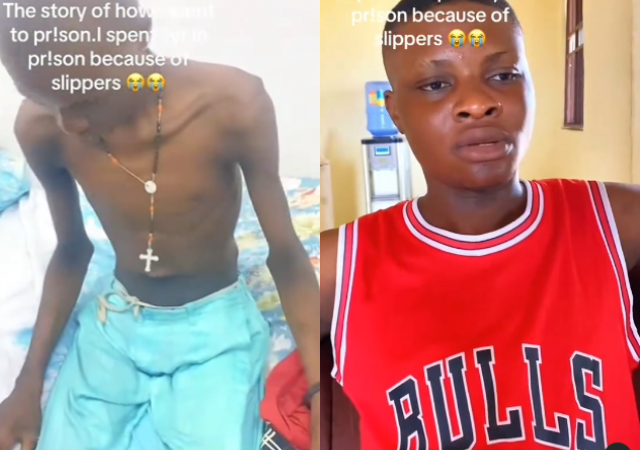
Wisdom Elijah, a hardworking Nigerian keke (tricycle) driver in Port Harcourt, spent almost a year in prison over a misunderstanding involving a pair of slippers. His ordeal, which he shared on social media, sparked outrage and raised concerns about how law enforcement and the courts treat the poor.
According to Wisdom, it all started on January 6, 2024, after he finished work for the day. A friend invited him to a birthday party, and on their way back, his tricycle suddenly ran out of fuel. Stranded, they decided to stop at a nearby house where a woman sold black-market petrol.
While they waited, Wisdom’s friend noticed that his slippers had gone bad. Without thinking much of it, he picked up a pair left outside, intending to wear them home. However, he failed to inform anyone, not even Wisdom.
Shortly after, the slippers’ owner realized they were missing and immediately accused both men of theft. Although Wisdom tried to explain the situation, the woman refused to listen. Her husband soon got involved and, without hesitation, called the police. Within minutes, officers arrived and took them into custody.
“I pleaded with the woman, explaining it was a misunderstanding, but she refused to listen and kept calling us thieves,” Wisdom recalled.
For the next three days, they remained in police custody, assuming the issue would be resolved quickly. Unfortunately, things took a drastic turn when they were taken to court, where the judge set bail at ₦80,000.
At this point, Wisdom’s friend managed to secure bail through his family’s support and walked free. Meanwhile, Wisdom faced a harsher reality. Without money or immediate family assistance, he had no choice but to remain behind bars.
“I had no one to call and no money to meet the bail conditions,” he said.
From then on, prison life became unbearable. The overcrowded cells, scarce food, and poor sanitation drained his strength. As weeks passed, his health deteriorated rapidly, and he lost a significant amount of weight.
“The environment was harsh, and survival became a daily struggle,” he admitted. Despite his suffering, there was no clear end in sight.
Finally, after nearly a year, on December 3, 2024, authorities granted him release. When he stepped out, his frail appearance shocked many. Within hours, his story spread like wildfire across social media, igniting public outrage and demands for justice reform.
Wisdom’s case brought to light deep flaws in Nigeria’s legal system, where minor offenses often lead to life-altering consequences, particularly for those who cannot afford bail.
Legal analyst Adaora Okafor strongly condemned the situation, stating:
“Wisdom’s experience highlights the urgent need for judicial reforms. especially concerning bail conditions and the treatment of minor offenses. No one should suffer such hardship over a misunderstanding.”
As a result, his ordeal has become a focal point in discussions about how the justice system treats petty crimes and the broader implications for individuals lacking financial resources, with many asking: How many more innocent people remain in prison simply because they lack money to buy their freedom?
In the end, Wisdom’s story serves as a tragic reminder of the urgent need for change in Nigeria’s justice system.