
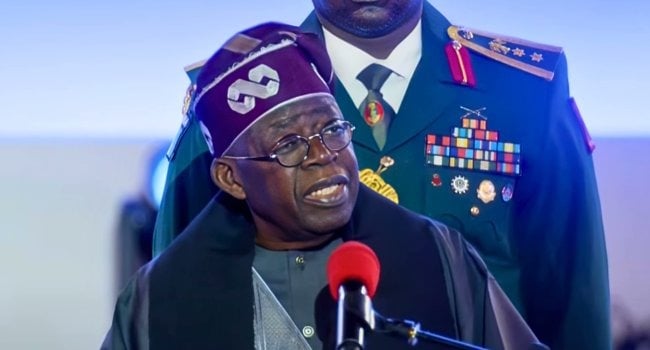
President Bola Tinubu has declared that the Economic and Financial Crimes Commission (EFCC) has recovered more than ₦500 billion and secured 7,000 convictions in the first two years of his administration.
Speaking through Vice President Kashim Shettima at the opening of the 7th EFCC-NJI Capacity Building Workshop for Justices and Judges in Abuja on Monday, Tinubu praised the Commission’s efforts in the anti-graft war, describing its performance as a strong proof of his administration’s resolve to fight corruption.
According to EFCC spokesman, Dele Oyewale, Tinubu said proceeds of recovered crimes were being reinvested into the economy through key social programmes like the Students Loan and Consumer Credit schemes.
“The EFCC, for example, has recorded over 7,000 convictions in the first two years of the present administration and recovered assets in excess of ₦500bn,” Tinubu said.
“Recovered proceeds of crime have been ploughed back into the economy to fund critical social investment programmes.”
Tinubu stressed that the success of the anti-corruption drive depends on collaboration among all arms of government, adding that judges play a crucial role in ensuring accountability and justice.
> “A Nigeria free of corruption is possible if we all commit to doing what is right in our respective spheres of influence,” he said. “Courts and judges are strong pillars of the anti-corruption process.”
The President also warned that the credibility of the fight against corruption would collapse if public officials fail to lead by example.
“We cannot claim to have excelled in our pursuit of a transparent system if we do not live by such examples,” he added.
ALSO READ: Japan’s Sanae Takaichi becomes country’s first female prime minister
Tinubu noted that corruption continues to undermine development and fuel insecurity, urging every Nigerian to unite in confronting it.
Meanwhile, EFCC Chairman Ola Olukoyede raised concerns about persistent court delays and legal technicalities that have slowed the progress of several high-profile corruption cases.
He lamented that some of these cases have been stuck in court for 15 to 20 years, often due to tactics used by politically exposed persons to frustrate trials.
“When investigations are concluded, getting politically exposed persons to appear in court is a Herculean task. When that hurdle is crossed, other antics begin, from fake illnesses to endless adjournments,” Olukoyede said.
He warned that the “weaponisation of procedures” and the prioritisation of technicalities over justice threaten the integrity of the judiciary and the anti-corruption crusade.
“When cases drag in court, witness fatigue sets in, memories fade, and sometimes witnesses or prosecutors die or move on. The only victor in such situations is corruption,” he said.
Olukoyede also accused some state high court judges of issuing ex parte orders to obstruct EFCC investigations, despite lacking jurisdiction over financial crimes.
He expressed concern over contradictory judgments in similar corruption cases and the use of frivolous applications by some senior lawyers to delay justice.
“These antics leave society with the impression that the courts and prosecution are not keen about justice,” the EFCC boss said.