
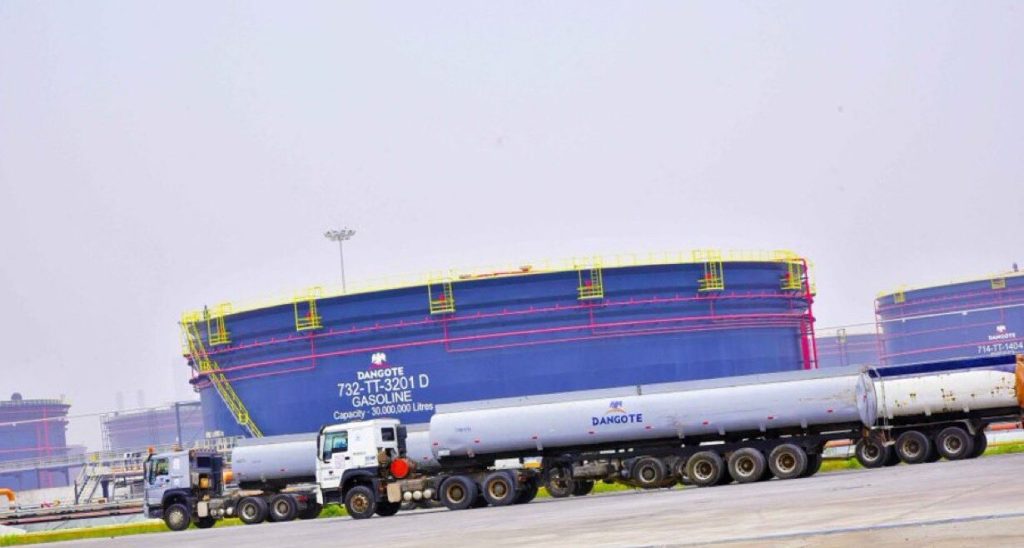
The Dangote Petroleum Refinery has dismissed shutdown rumour claiming that its petrol production unit may be shut for up to three months, describing the publication as false.
A spokesperson for the Dangote Group, Anthony Chiejina, said the report, attributed to Reuters, was “fake news.” Reuters had cited industry monitor IIR Energy, alleging that the refinery’s 204,000 barrels-per-day Residue Fluidised Catalytic Cracking Unit (RFCCU) was shut on August 29 due to catalyst leaks, with possible delays in restarting until major repairs were completed.
In its report, Reuters suggested the facility “could” remain offline for two to three months. Reacting to this, Chiejina questioned the credibility of the report.
The Dangote refinery, Africa’s largest with a 650,000 barrels-per-day capacity, began operations in January 2024. Since then, it has significantly reshaped fuel trade flows. Exports of petrol from Europe to Nigeria have dropped from about 200,000 bpd in 2024 to around 120,000 bpd in the first half of this year, according to energy analytics firm Kpler.
The refinery has also achieved new milestones, including shipping two gasoline cargoes to the United States East Coast, expected to land in New York later this month. The move is seen as proof that Dangote’s output meets stringent US standards.
ALSO READ:‘Jeun ko ku’: Fela couldn’t afford food despite hit song — Femi Kuti
Plans are also underway to ramp up operations to 700,000 bpd by December 2025. In August, the refinery imported its first cargo of Ghana’s Sankofa crude, a medium-sweet grade, adding to a growing list of international feedstocks such as Brazilian Mero, Tupi, and Angolan Pazflor.
Despite progress, Dangote has repeatedly raised concerns over the difficulty of sourcing enough domestic crude. Minister of State for Petroleum Resources (Oil), Heineken Lokpobiri, recently stressed the need to boost Nigeria’s production to meet both local and international demand.
Kpler data shows crude deliveries to the refinery hit a record 570,000 bpd in July, with US light sweet crude making up 60 per cent of the supply, overtaking Nigerian grades for the first time. The refinery currently operates at an estimated 445,000 bpd, about 68 per cent of capacity, with output expected to remain stable except for a routine maintenance dip in December and January.