
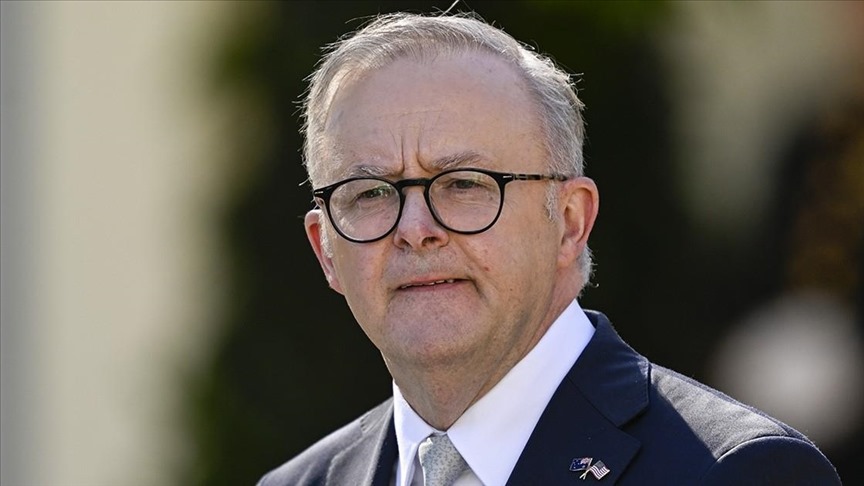
Australian Prime Minister Anthony Albanese said on Tuesday that a father and son were driven by “Islamic State ideology” when they opened fire on crowds at Bondi Beach in one of the deadliest mass shootings in Australia’s history.
Sajid Akram and his son, Naveed, opened fire on people gathered at the popular beach to mark the Jewish festival of Hanukkah on Sunday evening, killing 15 people and injuring dozens more.
Authorities said the attack was aimed at instilling fear within the Jewish community, though they have so far provided limited details about the assailants’ deeper motivations.
Albanese said the remarks offered one of the strongest indications so far that the pair had been radicalised by an “ideology of hate”.
“It would appear that this was motivated by Islamic State ideology,” Albanese told national broadcaster ABC.
“With the rise of ISIS more than a decade ago now, the world has been grappling with extremism and this hateful ideology,” he said in a separate interview, using another name for the Islamic State group.
Australian media reported that the two had travelled to the Philippines before the attack, with investigators probing whether they encountered Islamist extremists during the trip. Manila’s immigration department confirmed to AFP that they spent most of November in the Philippines, with Davao listed as their final destination.
The province, on the southern island of Mindanao, has a long history of Islamist insurgencies against the central government.
Immigration records identified Sajid as an Indian national and his son as an Australian citizen, according to spokeswoman Dana Sandoval.
Police said a car registered to Naveed Akram was discovered near the beach after the shooting, containing improvised explosive devices and “two homemade ISIS flags”, New South Wales Police Commissioner Mal Lanyon said.
ALSO READ: Elon Musk becomes first person to hit $600bn net worth
Authorities are also facing increasing questions over whether the attack could have been thwarted.
Albanese said Naveed Akram, described in reports as an unemployed bricklayer, had come to the attention of Australia’s intelligence agency in 2019 but was not considered an imminent threat at the time.
“They interviewed him, they interviewed his family members, they interviewed people around him,” Albanese said.
“He was not seen at that time to be a person of interest.”
Police are continuing to reconstruct the pair’s movements in the days leading up to the attack.
Naveed reportedly told his mother on the day of the shooting that he was leaving the city for a fishing trip.
Investigators now believe he was instead staying in a rented apartment with his father, where the attack was planned.
Armed with long-barrelled firearms, the pair fired on the beach and a nearby park for about 10 minutes before police shot and killed 50-year-old Sajid.
Naveed, 24, remains in a coma in hospital under police guard.
(AFP)