
On Sunday, December 21, 2025, twenty-four African nations set out on a month-long journey at the Africa Cup of Nations, hosted by Morocco. It was a tournament the continent looked forward to, and one that also drew the attention of the global football community.
AFCON 2025 promised many things. Contrasting styles of play, tactical diversity, continental pride, and the return of African stars who dominate Europe’s biggest leagues. It was also a rare opportunity for home-based players to announce themselves on a global stage and prove that African football is deeper than its exports.
In many ways, the tournament delivered on the pitch. Away from it, however, AFCON 2025 exposed familiar problems. Officiating inconsistencies, poor game management, and chaotic moments once again raised uncomfortable questions about African football’s readiness for bigger responsibilities.
A Final That Lost Control
Senegal emerged champions after defeating hosts Morocco 1–0 in extra time, thanks to a Pape Gueye goal four minutes into the additional 30 minutes, following a goalless draw in regulation time at the Prince Moulay Abdellah Stadium in Rabat.
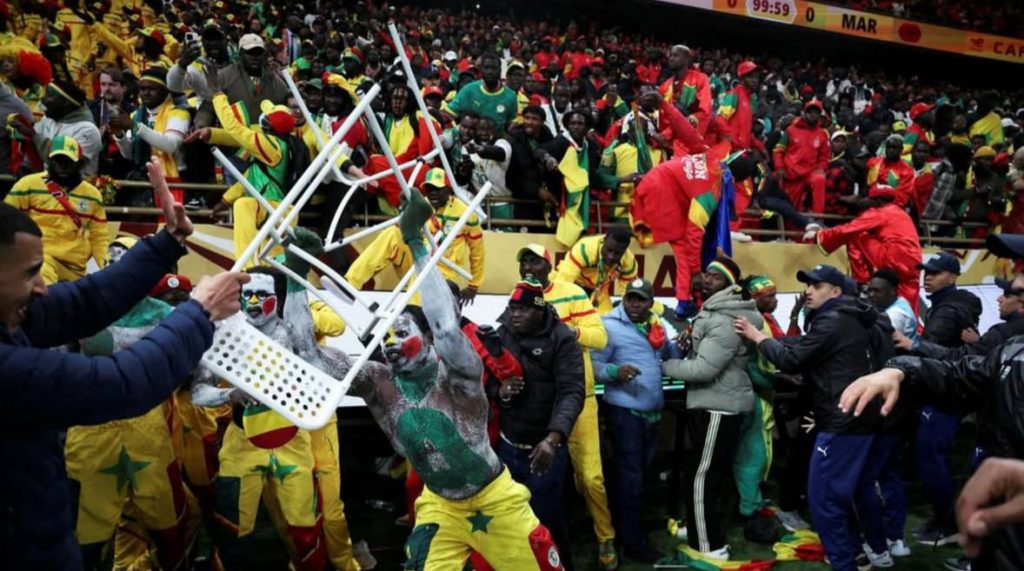
But the final will be remembered less for the football and more for the disorder that preceded the decisive moment.
In the 98th minute of normal time, referee Jean-Jacques Ndala awarded Morocco a penalty after a VAR review of El Hadji Malick Diouf’s challenge on Brahim Díaz. What followed was nothing short of chaos.
Senegal head coach Pape Thiaw, furious at the decision, instructed his players to leave the pitch in protest. For several minutes, the game stood still. Only Sadio Mané, one of African football’s most experienced professionals, was seen attempting to calm the situation and persuade his teammates to return.
The delay lasted roughly 17 minutes. Had Senegal refused to resume play, Morocco would have been awarded the title by default. That would have been an ending that disfigured what had otherwise been a compelling tournament.
When play finally resumed, Brahim Díaz, who finished as the tournament’s top scorer with five goals, missed the penalty. Given the disorder surrounding the incident, he would be justified in arguing that the disruption affected his focus. His effort, a poorly executed Panenka, summed up the moment. It was rushed, chaotic, and ill managed.
ALSO READ: AFCON win: Senegal declares Monday public holiday
Not an Isolated Incident
Unfortunately, the final was not an isolated case.
Earlier in the tournament, Nigeria’s semi-final clash with host nation Morocco was marred by officiating decisions that many observers found questionable. Despite the referee and VAR officials being from Ghana and South Africa, the match featured calls that appeared consistently favourable to the hosts.
Whether bias existed or not, perception matters. Once again, AFCON found itself battling the same old narrative. Poor officiating and a lack of trust in match officials during high-stakes games.
For a competition of AFCON’s magnitude, this should not be the story. Yet once again, it was the loudest one.
What This Means for Africa
African football has never been without drama. Every major international tournament, AFCON included, comes with its own intensity, pressure, and controversy. That is not the problem.
The issue is repetition.
When scenes of chaos, protests, officiating confusion, and game delays dominate headlines more than the football itself, the image of the competition, and the continent, suffers.
FIFA president Gianni Infantino, who was present at the final, condemned the events that marred Senegal’s victory.
“We strongly condemn the behaviour of some supporters as well as some Senegalese players and technical staff members. It is unacceptable to leave the field of play in this manner,” Infantino said.
His words cut deep, not because they were harsh, but because they were familiar.
Many of the players involved compete weekly in Europe’s most structured leagues. Others are home-based talents hoping AFCON serves as a pathway to bigger careers. Moments like these do not just embarrass federations. They risk sabotaging the futures of players and officials alike.
The World Cup Question
Africa has long pushed for the chance to host the FIFA World Cup. The talent is unquestionable. The passion is unrivalled. The infrastructure, in places like Morocco, is improving rapidly.
But tournaments are not judged by stadiums alone.
How can the continent make a convincing case for hosting the world’s biggest football event when it still struggles to manage its own flagship competition without controversy? How can Africa demand greater trust when refereeing standards, player discipline, and administrative control continue to falter on the biggest stages?
These are uncomfortable questions, but they are necessary ones.
Not All Doom and Gloom
To reduce AFCON 2025 to its controversies alone would be unfair.
The tournament produced moments of genuine quality and joy. Fans were treated to outstanding performances from stars like Mohamed Salah, Victor Osimhen, Sadio Mané, Ademola Lookman, Brahim Díaz, Franck Kessié, Bryan Mbeumo, Ismaïla Sarr, Yassine Bounou, and Omar Marmoush.
Nigeria claimed bronze after defeating Egypt on penalties in the third-place match on January 17. Across the tournament, both home-based and foreign-based players rose to the occasion, carrying the hopes of their nations with pride and responsibility.
The football was there. The talent was never in doubt.
What Must Change
If African football wants more, more respect, more responsibility, and ultimately bigger tournaments, then improvement must start from within.
Officiating standards must be raised and protected from doubt.
Players and coaches must show greater discipline in moments of adversity.
Administrators must manage matches with authority, clarity, and consistency.
Infrastructure must go beyond beauty and include efficiency, security, and professionalism.
AFCON 2025 reminded the world of Africa’s immense footballing potential. It also reminded us that potential alone is not enough.
The football was African.
Sadly, so were the problems.
By Damilola Atobatele